
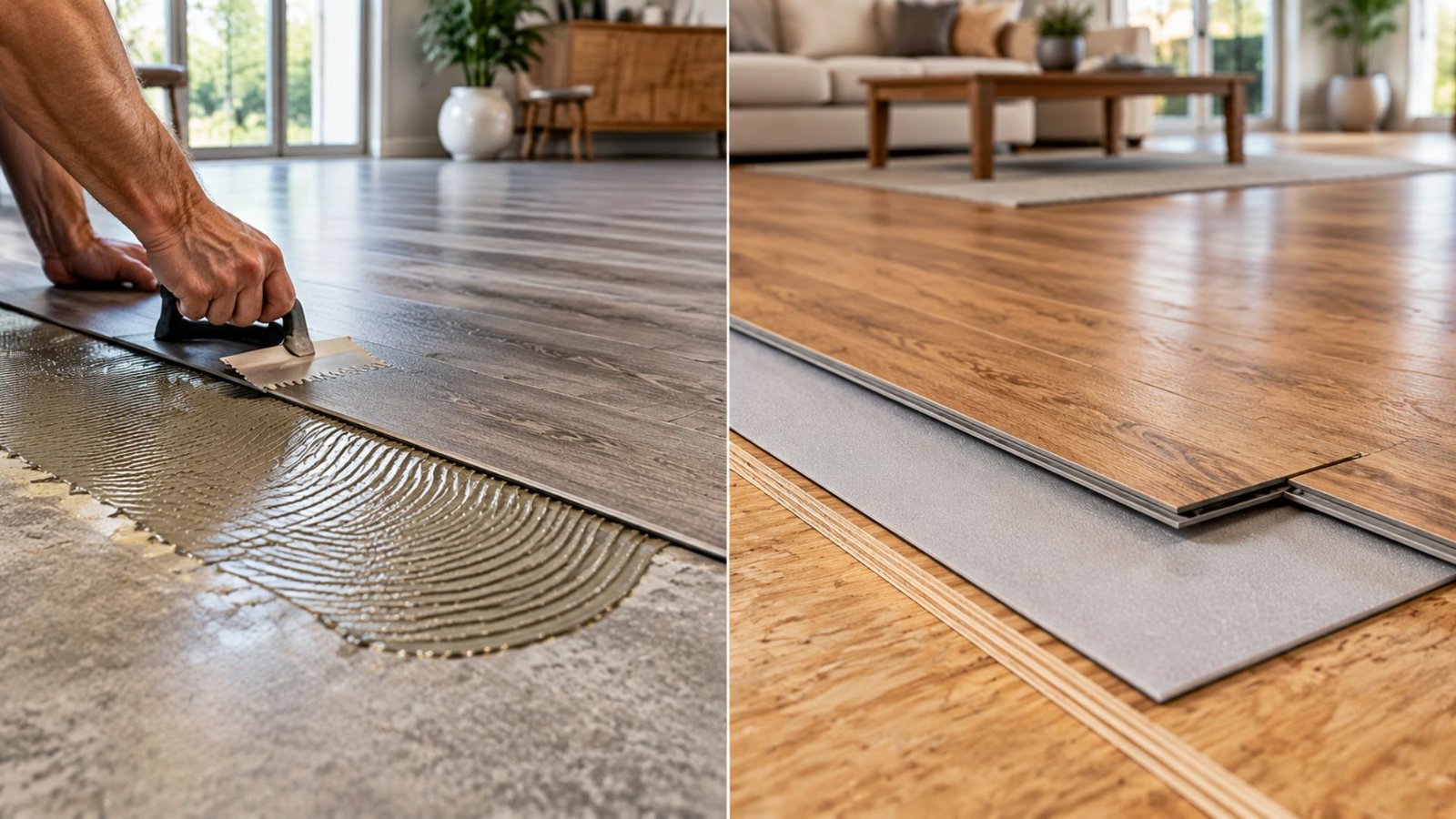
Glue-Down Vs Floating Vinyl: Your Subfloor Decides the Winner
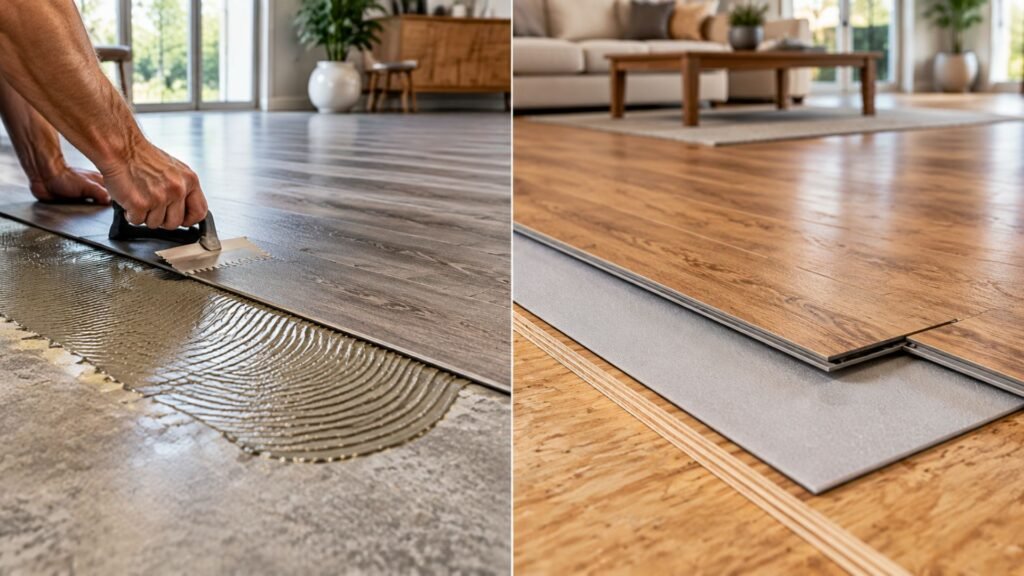
Choosing between glue-down and floating vinyl floors can feel like picking a side in an argument where both sides sound convincing. One installer swears by glue. Your neighbor loves their floating floor. And you’re standing in the middle, just trying to figure out what works best for your home.
Here’s the thing nobody tells you upfront: the right answer almost always comes down to your subfloor. Not your style preferences. Not your budget (though that matters too). Your subfloor is the real deciding factor – and once you understand why, the choice gets a lot clearer.
What Are We Actually Comparing?
Before getting into subfloor specifics, it helps to know exactly what each installation method involves.
Glue-down vinyl is exactly what it sounds like. Each plank or tile is bonded directly to the subfloor using adhesive. The flooring becomes a fixed part of the surface beneath it, with no room to shift.
Floating vinyl doesn’t attach to the subfloor at all. Instead, the planks lock together using a click-and-lock system and simply rest on top of the subfloor. The floor moves as one connected unit rather than being anchored in place.
Both methods use luxury vinyl planks (LVP) or luxury vinyl tile (LVT), so the material itself can look identical. The difference is entirely in how it’s installed – and that’s where your subfloor enters the conversation.
Why Your Subfloor Is the Starting Point
Most homeowners think about flooring from the top down. They pick a style, a color, a texture. Then they hand it off to an installer and hope it goes well. But experienced flooring contractors think about it from the bottom up – because a beautiful floor on a bad subfloor is a problem waiting to happen.
Your subfloor is the layer beneath your finished flooring. It could be concrete, plywood, or an existing floor like tile or hardwood. Each of these surfaces has its own characteristics – moisture levels, texture, flatness, and flexibility – that directly affect which vinyl installation method will perform best.
Getting this wrong doesn’t just affect how your floor looks. It affects how long it lasts, how it feels underfoot, and whether you’ll be ripping it up in a few years.
Glue-Down Vinyl: When Your Subfloor Calls for It
What Makes Glue Down the Right Choice
Glue down vinyl is the more demanding installation method. It requires a clean, smooth, and flat subfloor – typically within 3/16 of an inch over a 10-foot span. Any bumps, dips, or imperfections will telegraph through the vinyl over time, and you’ll feel them with every step.
That said, when your subfloor is ready for it, glue-down vinyl delivers a level of stability that’s hard to beat. It feels solid underfoot. It doesn’t shift, buckle, or make hollow sounds when you walk across it. In high-traffic areas or rooms with heavy furniture, that stability matters a lot.
Concrete Subfloors and Glue-Down Vinyl
Concrete is where glue-down vinyl really shines. Concrete is rigid, dense, and doesn’t flex – which is exactly the kind of surface that allows adhesive to form a lasting bond. Basements, slab-on-grade homes, and ground-level rooms with concrete subfloors are prime candidates for glue-down installation.
One important caveat here: moisture. Concrete and moisture go together like a bad marriage. Before any adhesive goes down, you need to test for moisture vapor emissions. In Dallas, Texas, where humidity and soil conditions can affect slab moisture levels, skipping this step is a mistake that shows up later – usually as adhesive failure or warped planks.
Glue Down Advantages Worth Knowing
- Dimensional stability – The floor won’t shift underfoot or gap at the seams over time.
- Better for radiant heat – If you have in-floor heating, adhesive installation keeps the vinyl in consistent contact with the heat source.
- Works well in commercial and high-traffic settings – Retail spaces, kitchens, and entryways benefit from the locked-down feel.
- Thinner profiles – Glue-down vinyl tends to be thinner (around 2-4mm), which works well in rooms where door clearance is tight.
The Trade-Offs With Glue-Down
The adhesive doesn’t forgive subfloor imperfections. If your concrete has cracks, humps, or texture, you’ll need to level and prep it before installation – and that’s additional time and cost.
Glue-down vinyl is also harder to remove later. If you want to change your flooring in the future, expect a more labor-intensive process. The adhesive bonds over time, and removing it without damaging the subfloor takes effort.
Floating Vinyl: When Flexibility Is the Advantage
What Makes Floating the Right Choice
Floating luxury vinyl plank is more forgiving – and that’s not a knock against it. In many situations, that forgiveness is exactly what you need.
Because the planks click together and rest on the subfloor, the floor has a small amount of room to expand and contract with temperature changes. In a city like Dallas, Texas, where summers push triple digits and indoor temperatures can fluctuate, that built-in flexibility is genuinely useful.
Floating vinyl also tolerates slightly less-than-perfect subfloors. You still need reasonable flatness – but minor imperfections won’t compromise the adhesive bond because there is no adhesive. The underlayment (often built into the plank itself) helps bridge small variations in the subfloor surface.
Plywood Subfloors and Floating Vinyl
Plywood subfloors are common in older homes and second-story rooms in Dallas. Wood-framed floors have some natural flex to them, and that movement over time can stress a glue-down installation, causing adhesive to fail or seams to open up.
Floating vinyl handles that flex much better. Because the floor moves as a single unit rather than being bonded to a moving surface, it’s less likely to crack, gap, or delaminate when the wood subfloor moves seasonally.
This is one of the most important reasons why subfloor type drives the installation decision. The same vinyl plank that performs beautifully as a floating floor on plywood might fail prematurely if glued down on that same surface.
Installing Over Existing Floors
One of floating vinyl’s biggest advantages is its ability to go directly over certain existing floors – ceramic tile, for instance, or even older hardwood – without full removal. This can save significant time and labor costs on a remodel.
There are limits to this approach. The existing floor needs to be structurally sound, well-adhered, and not adding excessive height. But for homeowners looking to update a room without a full gut job, floating vinyl over an existing stable surface is a practical option worth discussing with your contractor.
Floating Vinyl Advantages Worth Knowing
- Easier installation and removal – No adhesive means faster installs and simpler future removal.
- Handles temperature fluctuations better – The floating system accommodates expansion and contraction.
- Forgiving on minor subfloor imperfections – Especially with a quality underlayment.
- Can go over existing floors – In the right conditions, no demolition required.
- DIY-friendly option – Though professional installation is always recommended for best results.
The Trade-Offs With Floating Vinyl
Floating floors have a slightly hollow sound when you walk on them. It’s not dramatic, but in rooms where that matters – like a quiet bedroom or a formal dining room – some people find it noticeable. A high-quality underlayment reduces this significantly.
Floating vinyl also needs expansion gaps around the perimeter of the room. If those gaps aren’t properly managed, the floor can buckle when it expands. And in rooms larger than roughly 30 feet in any direction, most manufacturers recommend glue down or a hybrid approach.
Head-to-Head: Which Method Wins in Different Situations?
Rather than declare one method universally better, here’s how each one performs across common home scenarios:
- Concrete basement or slab-on-grade room – Glue down generally wins, provided moisture testing clears. The concrete is rigid, the adhesive bond holds well, and the stability is noticeable.
- Second-story room with plywood subfloor – Floating vinyl is typically the better fit. The wood flex is a real factor, and floating floors handle it without the risk of adhesive failure.
- Kitchen or bathroom with high moisture potential – Moisture matters more than installation method here. Either can work with proper prep and the right product, but glue down with a moisture-barrier adhesive is often recommended in wet areas.
- Room with radiant heat – Glue down wins here. Floating floors with radiant heat can develop hot spots or gaps at the expansion joints if the system isn’t calibrated carefully.
- Existing tile or hardwood you want to keep – Floating vinyl is the practical choice, assuming the existing floor is solid and at an appropriate height.
- Commercial space or high-traffic retail – Glue-down provides the stability and durability commercial environments demand.
Subfloor Prep: The Step That Determines Everything
No matter which installation method you choose, your subfloor prep will make or break the result. This is where experienced flooring contractors earn their value.
For glue-down, prep involves patching cracks in concrete, grinding down high spots, filling low areas with self-leveling compound, and confirming moisture levels are within acceptable limits. On plywood, you’ll need to check for soft spots, secure any loose panels, and sand down edges where panels meet.
For floating vinyl, prep is slightly more forgiving, but it still matters. Significant dips or humps will cause planks to flex in ways that eventually stress the locking joints. A professional assessment before installation gives you a clear picture of what your subfloor actually needs.
In Dallas homes – especially older builds in neighborhoods with clay-heavy soil – slab movement is a known issue. That movement can affect both the subfloor condition and the long-term performance of your flooring. Working with a contractor who understands local conditions is a meaningful advantage here.
What About Glue Down Vs Floating for LVP Specifically?
Luxury vinyl plank (LVP) is one of the most popular flooring materials right now, and it’s available for both installation methods. But not all LVP is designed for both approaches.
Thinner LVP (2-3mm) is typically glue-down only. It’s flexible enough to bond flat but too thin to click-lock reliably. Thicker LVP (6-12mm) is usually designed as a floating floor, with a rigid core – often called SPC (stone plastic composite) or WPC (wood plastic composite) – that gives the planks enough structure to lock together and perform without adhesive.
When you’re selecting your vinyl planks, check the manufacturer’s installation specs. The material itself will often tell you which method it’s designed for, which narrows the decision-making considerably.
Common Mistakes Homeowners Make With Vinyl Flooring Installation
Even with the right material and method, certain mistakes show up repeatedly. Knowing them ahead of time can save you real money.
- Skipping moisture testing. Especially on concrete. Moisture vapor doesn’t have to pool visibly to cause problems. Testing is fast, inexpensive, and non-negotiable before glue-down installation.
- Not acclimating the flooring. Floating vinyl in particular needs time to adjust to the room’s temperature and humidity before installation. Rushing this step causes the planks to expand after installation, leading to buckling.
- Ignoring subfloor flatness. Even for floating floors, a subfloor that varies by more than 3/16 inch per 10 feet needs attention. Skipping this shows up as clicking joints, flexing planks, and failed locking mechanisms.
- Installing without proper expansion gaps. Floating floors need room to breathe. No gap means the floor has nowhere to go when it expands, and it will buckle into whatever space it can find.
- Choosing the wrong adhesive for glue-down. There are different adhesives for different subfloor types and vinyl products. Using the wrong one – or diluting it to stretch the supply – is a common shortcut with expensive consequences.
How Dallas Conditions Affect the Decision
Dallas sits in a part of Texas with hot summers, variable humidity, and expansive clay soil under a significant portion of the metro. These local conditions are genuinely relevant to your flooring decision.
The clay soil beneath many Dallas homes shrinks and swells with moisture changes. That movement transfers to concrete slabs over time, which means slab cracks and settlement are more common here than in regions with more stable soil. For glue-down vinyl, that means subfloor assessment is especially important before committing to an adhesive installation.
For floating vinyl, Dallas heat and the significant temperature difference between summer outdoor temperatures and air-conditioned interiors mean choosing a product with a good temperature-tolerance rating. Most quality LVP can handle surface temperatures of 85-90 degrees Fahrenheit, but check the specifications if you’re installing it in a room with significant sun exposure.
Working with a local flooring contractor who knows Dallas construction conditions – soil, slab behavior, humidity patterns – puts you in a much better position than working from general installation guides written for average conditions.
Frequently Asked Questions
Is glue-down vinyl more durable than floating vinyl?
Not necessarily. Durability depends more on the quality of the vinyl product itself than on the installation method. A high-quality floating floor will outlast a low-quality glue-down product. That said, glue-down vinyl tends to feel more solid underfoot and may hold up better in commercial or extremely high-traffic settings.
Can I install floating vinyl over concrete?
Yes, you can. Floating vinyl over concrete works well as long as the concrete is reasonably flat and moisture levels are within acceptable limits. An underlayment with a moisture barrier is usually recommended for concrete subfloors.
How do I know if my subfloor is flat enough for vinyl installation?
A 10-foot straightedge or long level laid across the floor will show you gaps and high points. The general standard for most vinyl flooring is no more than 3/16 inch variation over a 10-foot span. Your flooring contractor will check this during the pre-installation assessment.
Does floating vinyl make noise when you walk on it?
It can have a slightly hollow sound compared to glue-down, but a quality underlayment significantly reduces this. Thick SPC core products (8mm and above) tend to feel and sound more solid than thinner options.
Which method is better for bathrooms?
Both can work in bathrooms, but moisture control is the primary concern. Glue down with a moisture-resistant adhesive and a waterproof vinyl product is often the preferred approach in full bathrooms. For half-baths or powder rooms, either method is typically fine.
Is floating vinyl harder to repair?
Actually, floating vinyl can be easier to repair. Because the planks aren’t adhesive-bonded, you can often remove and replace individual planks without disturbing the surrounding floor. With glue down, replacing a section requires breaking the adhesive bond, which is more involved.
Let Your Subfloor Guide Your Vinyl Flooring Choice
The glue down vs floating vinyl debate doesn’t have a universal winner. Your subfloor condition, room use, and local climate all factor into the right call. If you’re working with a concrete slab and stable conditions, glue down often wins. If you have a wood subfloor or need flexibility, floating vinyl is typically the smarter choice.
Getting this decision right from the start saves you time, money, and frustration down the road. For professional guidance and installation you can count on, explore Build Strong‘s flooring contractor services or call +1-972-802-3107 to talk through your project.